A Simple Framework for Understanding Laser Treatments
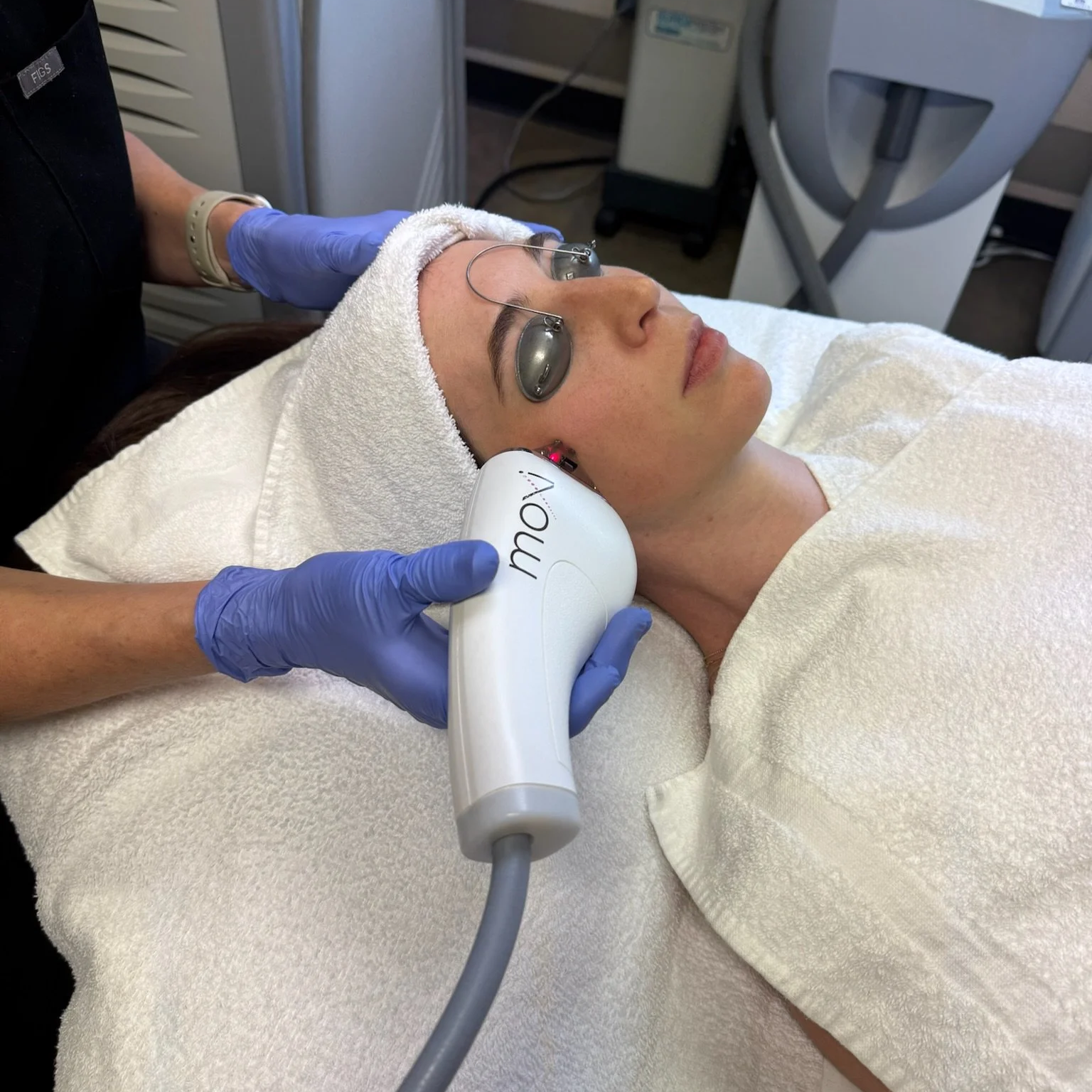
Moxi Treatment at Spa 170 West at Meridian Plastic Surgeons.
Lasers are confusing. There are so many names, so many options, and so much conflicting information online that it can be hard to know where to even start. So, my friends, let’s simplify things a bit.
Special shout out to Michele Gates and Kristy Simpson, two fabulous aestheticians in the Indianapolis/Carmel area who helped me put this together and make it as straightforward as possible.
What’s the Mechanism Behind Lasers?
The purpose of laser treatments is to reverse skin damage and signs of aging, and then to maintain those results over time. Lasers can also be preventative, which means they are pretty much right for everybody at many different stages–no matter your age or current skin type.
How do lasers actually work? By creating micro-injuries in the skin. Those micro-injuries trigger a degree of inflammation, and the body’s response to that inflammation is to produce collagen.
Recently, I’ve heard some anti-laser rhetoric from people who worry that lasers are burning the skin. The key thing to understand is that you do want a controlled level of injury because that is what drives collagen production. When laser treatments are done safely by a knowledgeable, experienced provider, they are incredible anti-aging tools.
First: Is Broadband Light (BBL) Even a Laser?
No. Broadband light (BBL) is phototherapy, not a laser. It’s used alongside lasers or on its own, and it is a great place to start this conversation. The main goal of BBL is to treat discoloration and irregularities in skin tone, including pinks, reds, and browns. A nice side benefit of BBL is improvement in skin texture.
Level I: BBL + Moxi
The most accessible entry point into laser treatments is the BBL and Moxi combination.
Moxi is a superficial laser that creates micro-injuries by gently “aerating” the skin. The main goal of Moxi is improving skin texture, including pore size and dryness. Moxi has a nice side benefit of treating discoloration, especially browns. It is a particularly effective tool for melasma because of this.
Who is a typical Level I patient? Well… me! Think someone in their mid-30s without significant sun damage who wants to start protecting their skin and getting ahead of signs of aging.
Recommended cadence: BBL+/- Moxi (depending on your skin and skin goals) at least twice a year, typically in fall and early spring (think October/November and March).
Level II: Halo
If we bump it up a level, now we’re talking Halo. Halo uses two wavelengths (1470 and 2940) and is both ablative, meaning it uses heat to vaporize cores of skin, and non-ablative. It treats a little bit of everything: texture, fine lines, surface roughness, and discoloration (reds and browns).
A typical Halo patient is someone in their mid-40s with more sun damage, greater loss of elasticity, and deeper, more visible lines. This patient might want to jump straight to Halo rather than starting at level I, though BBL and Moxi can still be used later for maintenance.
Recommended cadence: For the best results, Halo treatments are typically recommended every year and a half. In between Halo treatments, BBL treatments help to maintain the results from Halo and prevent additional skin damage. 1-2 BBL treatments per year are recommended.
Level III: Erbium and CO2 Lasers
For patients who need something beyond Halo, the most powerful resurfacing options are erbium and CO2 lasers. These are the most aggressive tools available for skin resurfacing and do require general anesthesia.
A typical Level III patient is someone in their mid-60s, or a patient in their 50s with significant cumulative sun damage. Smokers often fall into this category as well.
Recommended cadence: The results from this more aggressive laser resurfacing should last 10+ years. Once again, BBL treatments are recommended 1-2 times per year to help maintain the results achieved with erbium or CO2 resurfacing.
TL;DR
Laser treatments work by creating controlled micro-injuries that stimulate collagen production, and there's a level that's right for almost everyone.
BBL and Moxi are a great starting point for treating early signs of aging, and then for prevention and maintenance.
Halo is the next step up for more visible signs of skin aging.
Erbium and CO2 lasers are the most powerful resurfacing option for significant aging or sun damage.
The best way to figure out where you fall is to talk to an experienced provider who can assess your skin and build a plan that makes sense for you. Taking care of your skin is an investment, but SO worth it!